Cyber Physical Macro Matter
- Team
- Miguel Aflalo, Behrooz Tahanzadeh, Jingcheng Chen
- Thesis Advisers
- Dylan Wood, Maria Yablonina
- Supervisor
- Prof. Achim Menges (1st), Prof. Jan Knippers (2nd)
Our final ITECH thesis project explores a new paradigm of using robots in architecture by merging the line between the builders and building material. This can open new possibilities for adaptive construction methods and behaviorally programmed reconfigurable architecture. The cyber-physical material structure is comprised of smart digital units built from lightweight carbon fiber filament with integrated electronics for communication and sensing, which operate alongside a collection of autonomous aerial vehicles 'builders'.
Communication Setup
A multi-layer communication network is developed to establish communication between different agents. The messaging method of each layer is chosen based on hardware limitations and possible communication protocols. The communication between units happens over I2C consists of two wires. Theses low-level messages at higher levels are sent to a server computer over serial communication. From that point, the messages are dispatched to other agents over higher-level protocols such as WebSocket and UDP based on client requirements.
Unit Design
The physical units (digital material) is a six faces polyhedron space frame made of carbon fiber. This design is the result of different agents' limitations and capabilities. CFRP (Carbon fiber reinforced polymer) skeleton provides a very high ratio of covered area to weight. The size and uplift force of the builder determines The weight and size of each unit. The design of embedded electronics and their in-between connections determined The number of units sides. The internal structure was based on structural analysis and winding procedure and requirements. The fabrication process needed us to work with advanced fabrication techniques such as CNC milling, 3D printing, and carbon-fiber production.
Drone Development
The aerial builder robot was hexacopter designed to fit the requirements of the proposed system by taking the unit in size and payload into close considerations. The mounted gripper matched the geometry of the material and introduced positioning flexibility to counteract possible imprecision of the unit geometry inherent to a winding fabrication process.
Positioning
HTC Vive tracking system was utilized as an external positioning system. Thanks to this system, we were able to calculate the velocity and acceleration of drones in each frame. To detect the position of each unit, a positioning system based on IR Camera and 4 IR LED on each unit was developed.
Control System
Our customized PID controller was capable of calculating the velocity vectors and the output channel values for the radio transmitter. Later, an Arduino board was responsible for generating the correct PPM signal and sending through a transmitter to the drone. This approach allowed us to coordinate flight behavior with the other agents in this system.
Cyber Physical Macro Matter at Ars Electronica Center
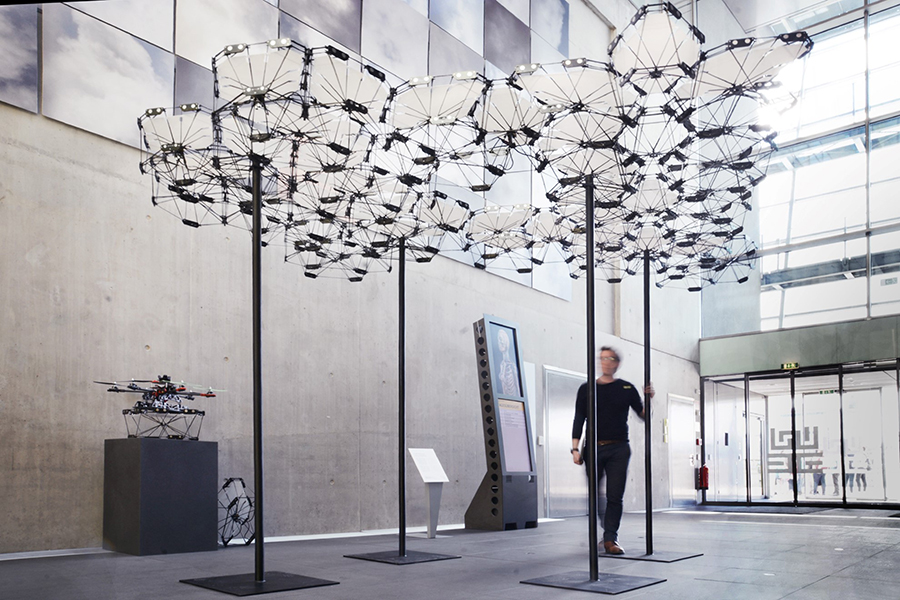
Our thesis project has been displayed at Ars Electronica center in Linz, Austria as part of "Creative Robotic 2018" exhibition. This exhibition presents a collection of projects in which robotic systems are being used outside of the industrial realm. Consisted of four columns and 50 smart units, this installation shows the architectural potential of such a system in larger scale.